A résumé tells you where I have been. A professional
bio tells you what I have done. Neither is especially
good at explaining how I think, what I notice, what
gives me energy, or what working with me is actually
like.
Think of this as the operating manual: part background,
part field guide, and very much a living document.
People are harder to summarize than software.
Systems > heroics
Context > guesswork
Deep work > calendar theater
Evidence + experience
How I think
Systems
Context
Evidence
Curiosity
The backstory
The route here was not especially linear.
Marketing and strategy make more sense as a destination
when you know some of the earlier stops. Performance,
entrepreneurship, public institutions, agency building,
large organizations, and graduate study all left
fingerprints on how I think about audiences, incentives,
power, evidence, and behavior.
The early chapter
I did not exactly plan on becoming a child performer.
Nobody in my family was in show business. The
story began when my elementary-school music
teacher decided I might be good at performing,
pulled me out of my first-grade class, and had
me audition for the school talent show.
Other parents apparently saw more promise in
that performance than in my youth-soccer career
and began encouraging my mother to get me into
show business. This was sensible advice:
I was an exceptionally bad soccer player.
She eventually relented.
Performing eventually took me to television,
print work, Off-Broadway, Nickelodeon, and
Star Search — essentially the
American Idol of its day.
One of the less glamorous but more educational
assignments involved demonstrating a then-new
handheld karaoke machine in the New York City
subway while commuters pushed past me to board
their trains. It turns out that convincing a
distracted stranger to care about what you are
saying is a fairly good introduction to
marketing.
A performer headshot from around age 11,
when “going to work” could mean television,
print, a casting call, or something
considerably stranger.
At Disney World during
Star Search — one of the major
televised talent competitions of its era.
Official school documentation from the
period. The administration apparently
took no position on the haircut.
What carried forward:
audiences do not owe you their attention.
Preparation matters. Presentation matters.
And the experience someone receives is usually
supported by much more machinery than the
audience ever sees.
The obsession before the business
Magic started with a disappearing drawer.
I was about six when I walked past a mall kiosk
and saw a little drawer apparently made empty
by magic. I was amazed.
A drawer box — the kind of wonderfully simple
illusion that started the obsession.
Then I saw David Copperfield on television —
leather jacket, mullet and all — making a
Harley-Davidson disappear while Van Halen
blasted in the background.
That was it. I was hooked.
As I got older, though, I noticed something
peculiar. Performers such as Copperfield and,
later, David Blaine were working very hard to
make magic feel contemporary, while much of
magic retailing still seemed trapped in an
earlier era.
What carried forward:
markets often contain opportunities not because
nobody is serving them, but because existing
businesses have stopped noticing how the
customer has changed.
Entrepreneurship
So I tried building the magic store I thought should exist.
I started a magic business aimed specifically
at novices and younger magicians — customers I
thought traditional dealers often failed to
speak to particularly well.
Instead of modeling the marketing on niche hobby
suppliers, I borrowed more from specialty
fashion retail: clearer presentation, more
contemporary merchandising, stronger branding,
and an experience designed around the customer
who wanted to enter the category rather than the
expert who already knew its language.
A $500 initial investment eventually became a
national business that benefited from magic's
unusual invasion of popular culture in the late
1990s and early 2000s.
The business eventually extended well beyond
retail. Magic & More developed corporate
accounts, including chain bookstores, and became
an official supplier of magicians for
Harry Potter book-release events. That
created an unexpectedly useful flywheel:
children and parents encountered one of our
performers at a bookstore event; some became
retail customers; and some later hired a
magician for a birthday party or other event of
their own. Retail, live performance, and
corporate relationships began feeding one
another.
Behind the display at a magic convention.
The $500 experiment had become a national
retail business — complete with inventory,
customers, convention specials, and
considerably more yellow shelving.
The positioning became more explicit:
younger faces, brighter packaging and
more contemporary merchandising.
The same idea reached the catalog:
sell an experience and a brand,
not merely a list of tricks.
What carried forward:
positioning, customer experience, small-business
economics, channel strategy, customer flywheels,
and an enduring interest in how apparently minor
design and communication choices change who
feels invited into a market.
Public institutions
Then my product became Philadelphia.
At the City of Philadelphia, I worked in a unit
focused on a problem the region was struggling
with in the early and mid-2000s:
brain drain.
The Philadelphia area was — and remains — home
to a remarkable concentration of universities,
including Penn, Temple, Villanova and many
others. The problem was that large numbers of
students would arrive, earn their degrees, and
promptly leave for opportunities somewhere else.
My work involved helping sell Philadelphia as
a place interesting enough to call home after
graduation, while connecting students and
recent graduates with professional opportunities
and further education in the region.
Directing a magazine-cover shoot while
working for the City of Philadelphia.
The larger assignment was place marketing:
convincing students and recent graduates
that Philadelphia was somewhere to build a
career, not merely earn a degree.
What carried forward:
place marketing, stakeholder complexity,
public institutions, and the realization that
attracting people is only half the problem.
An ecosystem has to give them reasons to stay.
Agency building
Then I learned the business by having to do almost all of it.
After leaving the City, I founded CrowdConnect,
a marketing and strategy agency I would go on to
run for nearly 17 years. Some of its first clients
were organizations I had originally worked with
during my time in Philadelphia government, which
gave the new agency an encouraging start.
Then those engagements ended, as engagements do,
and I discovered one of entrepreneurship's less
glamorous lessons: a promising beginning does not
constitute a pipeline. We hit a drought. I had
employees to pay, an office to keep open, and no
luxury of waiting for the ideal corporate account
to arrive.
So I started signing smaller businesses —
restaurants, boutiques, hospitality companies,
and other owner-operated organizations. At the
time, it felt mostly like survival. In retrospect,
it was one of the most useful stretches of my
career.
A large corporate account often gives an agency
responsibility for one slice of a much larger
system. A small-business client could hand us
nearly the whole thing. I might be working on
strategy, media buying, digital, print, direct
marketing, public relations, creative, promotions,
and measurement for the same client. There were
fewer organizational layers between an idea, its
execution, and the customer's response.
By the time CrowdConnect began winning larger
corporate clients again, I was considerably more
battle-tested. I knew not only how to lead a
creative team, but how to get a 300,000-piece
direct-mail campaign out the door on schedule and
on budget. I knew how to negotiate with major
media outlets when the brand I represented had
almost no leverage. And I had learned how to
attract talented people when I was in no position
to win them with market-leading compensation.
Over time, the agency moved steadily upmarket.
The work expanded into strategy, customer
experience, analytics, growth, and increasingly
complex organizational problems, eventually
including Fortune 1000 clients. At its peak,
CrowdConnect operated from offices in
Philadelphia, Moorestown, and Princeton.
Running the agency also meant that strategy and
execution could never remain comfortably separate.
I had to win the work, scope it, price it, staff it,
deliver it, preserve the relationship, manage the
economics, and build an organization capable of
doing all of that again.
What carried forward:
breadth before scale. Small clients taught me to
see the entire operating system; larger clients
later gave me the opportunity to apply those
lessons at much greater complexity. Strategy
became more useful once I understood what it
actually takes to get the work out the door.
Marketing & organizations
The corporate world made the system larger still.
After years of entrepreneurship and consulting,
my work moved deeper inside larger organizations,
expanding further into marketing, growth,
customer strategy, loyalty, analytics, brand,
technology, and organizational transformation.
The scale changed: larger data sets, larger
budgets, larger teams — and usually larger gaps
between what an organization intended to do and
what its systems actually allowed people to do.
The subject matter changed, but the questions
were familiar: How do people make decisions?
Which customers should we understand
differently? What incentives are shaping
behavior? Why does an apparently sensible
strategy produce a decidedly less sensible
result once an organization tries to execute it?
A more ordinary version of corporate life:
somewhere between customer strategy,
analytics, planning, and whatever those
charts on the wall were trying to tell me.
What carried forward:
measurement, segmentation, systems thinking,
organizational incentives, and growing
skepticism toward explanations that locate
every success or failure in one heroic —
or incompetent — individual.
Learning as a second track
Practice eventually sent me back to the classroom.
Graduate business education gave me a more
formal vocabulary for many of the questions I
had already encountered in practice: strategy,
organizations, economics, innovation,
negotiation, and the difficult business of
turning evidence into decisions.
It also pushed me toward research itself.
Increasingly, I became interested not merely in
knowing which managerial tools organizations
use, but in asking where those tools came from,
why they persist, what evidence actually
supports them, and what happens when practice
and theory disagree.
MBA graduation at Indiana University —
one chapter in the gradual convergence of
professional practice and research.
What carried forward:
the conviction that experience is useful,
evidence is useful, and each becomes more
interesting when it is allowed to challenge
the other.
Now
Research and practice increasingly talk to each other.
Today I move between applied business questions,
research, writing, and organizational problems.
I am especially interested in places where a
familiar managerial assumption becomes less
convincing once we examine the evidence,
incentives, power relationships, or people
living with the consequences.
What carries forward now:
turn practice into better questions, research
into usable ideas, and complexity into something
people can actually act on.
Operating system
Some things reliably add energy. Others reliably remove it.
This is less a list of preferences than a reasonably
accurate forecast of the conditions under which I do
my best work. Click either side to bring it forward.
+
More of this.
Deep dives into questions that are actually
worth understanding.
One-on-one conversations where people can think
out loud without performing for the room.
Well-researched arguments — including ones I
disagree with.
−
Less of this
(please!).
Endless meetings whose purpose appears to be
preparing for another meeting.
Passive aggression masquerading as
organizational diplomacy.
Magical thinking: confidence that reality will
eventually become more cooperative if we stop
measuring it.
Yes, the former magician is opposed to magical thinking.
Life is untidy.
A few recurring habits
How my brain tends to approach a problem.
These are not rules so much as defaults — the questions
and moves I tend to return to when a problem is
ambiguous, politically complicated, or suspiciously
easy to explain. Select a card to bring the idea
forward.
01
Look at the system.
I am usually less interested in identifying the
person who made a mistake than in understanding
the conditions that made the mistake likely.
Individual behavior matters; incentives, processes,
information, and structure often matter more.
02
Give me the context.
I have difficulty becoming genuinely engaged in an
assignment when I do not understand what larger
problem it is meant to solve. Tell me why it
matters, what decision it informs, and what happens
next.
03
Zoom in. Then out.
A customer, employee, or manager can make perfect
sense at one level of analysis and appear irrational
at another. I like moving between the individual
case and the larger organization or market around it.
04
Evidence meets experience.
“The data says” is not enough. Neither is
“I have been doing this for twenty years.”
I am most persuaded when evidence, experience,
theory, and judgment have been forced to confront
one another.
Practical instructions
How should we work together?
Pick the situation closest to what you need. The
selected card expands so the guidance that matters
most is easier to read.
What do you need from me?
Pick one
Quick answer
Start with the decision.
Chat or a concise message works well for
something genuinely quick. Give me two or three
lines of context, tell me what you need, and
make the decision or question visible rather
than making me excavate it from the background.
Best tool
Chat or concise message
Bring
Context + question
Best formula: context → question → deadline.
Deep dive
Give me the material.
Background rarely scares me. Send the research,
history, prior attempts, constraints, and
competing explanations. I would rather read
eight useful pages than spend forty-five minutes
in a meeting reconstructing information that
could have been sent beforehand.
Best tool
Written brief
Bring
Background + constraints
More context is useful when the context is actually useful.
Meeting
Give the calendar a reason.
Meetings work best for discussion, disagreement,
synthesis, or decisions — not for reading
material to one another. A clear purpose helps.
I also tend to do my strongest thinking later in
the day, so an afternoon conversation often
beats an early morning summons.
Best tool
Discussion
Bring
Agenda + decision
The calendar is a tool. It is not an operating model.
Feedback
Direct beats theatrical.
I respond well to a clear disagreement supported
by reasoning or evidence. Separate the judgment
from the person, explain what you are seeing,
and leave room for the possibility that either
of us may be missing something.
Best tool
Direct conversation
Bring
Specifics + evidence
Candor is useful. Performance aggression is not.
Conversation starters
Ask me about.
Some subjects reliably send me down a rabbit hole.
Open a card for the less résumé-like explanation of
why each one has stuck.
Marketing Strategy
Customers, loyalty, segmentation, positioning,
growth, measurement, and the machinery required
to make strategy real.
Open card
What interests me most is the point where
strategy stops being a PowerPoint noun and
becomes a set of choices about customers,
resources, capabilities, and tradeoffs.
I tend to be especially interested in the
uncomfortable middle: a company may know what
it wants the customer experience to be while
having incentives, technology, processes, or
organizational boundaries that make the desired
experience extraordinarily difficult to produce.
The recurring question:
what has to be true inside the organization for
the promise made to the market to become real?
Market Research
How we turn imperfect observations into
decisions — and how often certainty exceeds
what the evidence supports.
Open card
Research became interesting to me partly because
business has a peculiar relationship with
certainty. Managers often have to make a
decision before the evidence is complete, which
is perfectly reasonable. The problem begins
when the necessary decision gets retrospectively
converted into certainty that the evidence never
actually supplied.
I like research that makes the limits visible:
what do we know, what do we infer, what are we
assuming, and what evidence would cause us to
change our minds?
The recurring question:
how much confidence has the evidence actually
earned?
Travel
Hotels, airlines, cities, service design,
loyalty programs — and the pleasure of being
somewhere unfamiliar.
Open card
I love travel for its own sake, but it also
turns out to be a remarkably good way to observe
organizations in the wild.
Hotels, airlines, airports, restaurants, loyalty
programs, tourist attractions, and cities are
operating systems you can actually walk through.
Service design becomes tangible very quickly
when you are the person standing at a front desk
at midnight wondering why the system has decided
your reservation does not exist.
I also simply like being somewhere unfamiliar.
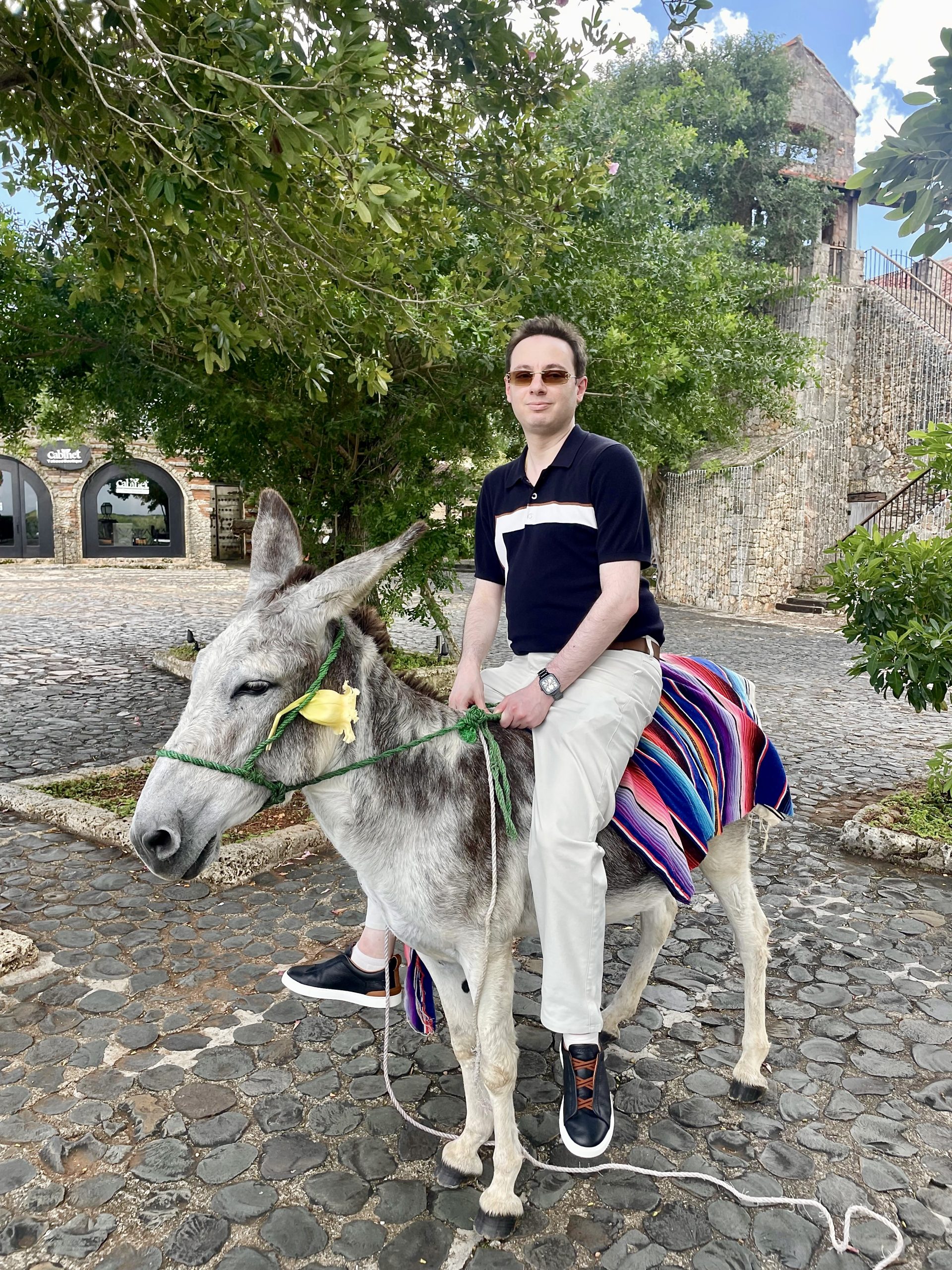
A different city changes what you notice —
and occasionally provides a donkey.
Bali. Some settings require very little
argument for getting out of the office.
Not every field visit produces a
rigorous dataset.
Mumbai — cities are particularly good
at challenging whatever assumptions
arrived with you.
Psychology
Judgment, personality, motivation, narratives,
perception, and our appetite for tidy causes.
Open card
Psychology became especially useful once I
started spending enough time inside
organizations to notice how rarely people behave
like the simplified economic actors contained
in a spreadsheet.
People respond to identity, status, narratives,
incentives, fear, social expectations, and their
interpretation of what everyone else is doing.
Something can look irrational from outside and
become quite understandable once the local
environment is visible.
The recurring question:
what does this behavior make sense in response to?
Negotiation
Interests, leverage, framing, relationships,
alternatives, and the difference between winning
a point and improving an outcome.
Open card
Negotiation appeals to me because it forces the
surface argument and the underlying problem to
separate.
Two people can disagree loudly about a position
while having interests that are much less
incompatible than the argument makes them look.
Conversely, pleasant conversation can obscure a
very real conflict over resources, risk, control,
or alternatives.
The recurring question:
what does each party actually need — and what
happens if no agreement is reached?
Magic & Illusion
Misdirection, attention, perception,
performance, and one field where making
something disappear counts as execution.
Open card
In the timeline above I mentioned seeing
David Copperfield make a Harley-Davidson
disappear on television. A couple of years
later, he did something that stuck with me
even more: he flew.
I remember the illusion being framed around the
much older human dream of flight, with an
emotional video sequence about people who had
tried to fly in the past and failed. Copperfield
then flew around the stage, through hoops, and
eventually inside a clear box designed to make
the possibility of hidden support seem even
less plausible.
What I remember most is how much the emotional
setup changed the effect. By the time the
impossible thing happened, it felt less like a
trick being demonstrated than the conclusion
of a story.
The lesson that stayed with me:
framing and packaging are not decorations added
after the performance. They are part of the
performance.
Frameworks are useful. Labels are less interesting.
I like self-assessment when it produces a better
question or a more useful behavior. I am less
interested in treating a typology as a verdict on who
someone is.
How I tend to learn.
Give me enough context to understand the whole,
let me ask questions, allow some room to examine
competing explanations, and then give me something
concrete to do with what I have learned.
I learn particularly well when theory and practice
can test one another rather than remaining politely
separated.
Put differently: I enjoy the rabbit hole. I would
still like it to lead somewhere.
What about personality and learning-style tests?
The original Personal User Manual includes
Honey & Mumford's learning framework and
the Explorer / Builder / Director /
Negotiator framework associated with
Helen Fisher and colleagues'
Fisher Temperament Inventory (FTI).
I use frameworks like these as prompts for
reflection, not as fixed descriptions of
what a person is.
I deliberately leave MBTI out. It remains
enormously popular, and some of its scales
overlap with broader personality traits, but
I do not find its four-letter typology or
the idea of sharply distinct psychological
“types” empirically persuasive enough for
the weight organizations often place on it.
A personality framework should make us more
curious about people, not more certain that
four letters have explained them.
Start with the larger problem and then show me
how the pieces fit together. I generally retain
details better when I understand the structure
that gives those details meaning.
What happens when the evidence changes?
Ideally, the conclusion changes too. I can
become attached to an argument like anyone else,
but I would rather revise the position than
protect it after the underlying facts stop
cooperating.
What kind of disagreement is productive?
Specific disagreement. Show me the assumption
you reject, the evidence you interpret
differently, or the consequence I have
overlooked. “I don't agree” is a starting point;
it is not yet an argument.
The shortest possible version
Curious, contextual, and suspicious of easy answers.
I like understanding how things work, especially
when the official explanation is incomplete. I
value people who are thoughtful, direct, generous
with information, and willing to change their
minds. Good work usually comes from making the
problem clearer before making the answer louder.