Published August 28, 2026
Glassdoor Employee Reviews: What They Reveal About Employee Voice and Employer Brand
An analysis of 604,320 public workplace reviews suggests that the familiar ratings for management, culture, opportunity, compensation and work-life balance contain a powerful shared judgment about the employer — while the words employees use, especially when describing what went wrong, add information the numbers do not fully capture.
Most organizations now operate, whether intentionally or not, with two employee-listening systems.
The first is the one they designed: engagement surveys, pulse checks, town halls, manager conversations, exit interviews, suggestion channels and perhaps an employee Net Promoter Score. These mechanisms allow the organization to decide what to ask, when to ask it, whom to ask and how the resulting information will be interpreted.
The second system exists largely outside the organization's control. On platforms such as Glassdoor, current and former employees evaluate management, culture, compensation, career opportunities and work-life balance while also describing, in their own words, what they believe an organization does well and where it falls short. Employers may monitor those reviews and sometimes respond to them, but they neither choose the questions nor control who participates, what employees decide to discuss or how prospective employees subsequently interpret what they find.
The difference is more consequential than it first appears. Public reviews are not simply another employee survey administered through a different interface; they combine structured workplace ratings with unsolicited narrative employee voice, creating a source of organizational information that is unusually rich while also being methodologically messy.
That combination raises several questions that are easy to overlook when employee-review data are reduced to a dashboard. If an employee gives poor scores to senior management, culture, career opportunities, compensation and work-life balance, for example, are those five ratings really identifying five distinct organizational problems, or are they partly five manifestations of a broader judgment that the organization is simply not a good place to work? Likewise, when employees supplement those ratings with open-ended descriptions of their experience, does the language provide information beyond the numbers — and, if it does, are positive and negative comments equally informative?
My project, Predicting Employee Recommendation from Public Workplace Reviews: Structured Ratings, Latent Evaluation, and Employee Voice, used a large public Glassdoor dataset to examine those questions through logistic regression, random forest modeling, exploratory factor analysis, sentiment analysis, text modeling and supplementary firm-level models. The analysis began as a machine-learning exercise focused on predicting employer recommendation, but the results ultimately raised a more interesting organizational question: what are employees actually communicating when they evaluate an employer?
The short answer: public employee reviews contain a powerful global evaluative signal. Five workplace subratings can be compressed into one latent factor with almost no loss in predictive performance, while open-ended employee voice adds information of its own — especially on the negative side of the experience. The relationship between negative-review sentiment and recommendation also varies across employers, although the mechanism behind that difference remains an open research question rather than a settled finding.
1. What are public employee reviews actually measuring?
A typical workplace-review platform combines two fundamentally different forms of information. The first is structured evaluation: employees separately rate dimensions such as work-life balance, culture and values, career opportunities, compensation and benefits, and senior management, creating the appearance of a multidimensional diagnostic instrument in which each score says something somewhat different about organizational life.
The second is employee narrative. Reviewers describe the organization's advantages and disadvantages in open-ended “pros” and “cons,” allowing them to introduce experiences, concerns, praise and vocabulary that the platform itself did not specify in advance.
That combination is analytically attractive because the structured ratings appear to tell us how employees evaluate different parts of the workplace, while the text can potentially tell us why. There is, however, an important measurement complication: an employee who has developed a strongly negative impression of an organization may genuinely believe that management is poor, advancement is limited, culture is unhealthy, compensation is inadequate and work-life balance is difficult, while the same overall impression that produces those judgments may also influence all five ratings simultaneously.
This possibility is consistent with the longstanding idea of the halo effect, in which a broader evaluative impression colors judgments of specific attributes, and with the problem of common-method variance when multiple measures come from the same respondent, in the same setting, at the same time. Neither problem makes the ratings meaningless, but both complicate the temptation to interpret a dashboard as though each score cleanly isolates an independent organizational cause.
When several workplace ratings move together, are they telling us about several different organizational conditions — or are they partly expressing a broader judgment of the employer as a whole?
2. How the Glassdoor analysis was conducted
The project used the original public Glassdoor Job Reviews dataset compiled by David Gauthier in 2017, which contained more than 800,000 employee reviews with both structured fields and open-ended text. Reviews were retained for the present analysis only when the recommendation field reflected a clearly positive or negative employer recommendation, leaving 604,320 observations.
The outcome was coded as a binary target — positive recommendation versus negative recommendation — while the initial structured predictors consisted of work-life balance, culture and values, career opportunities, compensation and benefits, and senior management. Current-versus-former employee status and review year were included as additional covariates.
| Workplace measure | General interpretation |
|---|---|
| Work-life balance | Perceived relationship between work demands and life outside work |
| Culture and values | Employee evaluation of the organizational environment |
| Career opportunities | Perceived development and advancement possibilities |
| Compensation and benefits | Evaluation of financial and nonfinancial rewards |
| Senior management | Evaluation of organizational leadership |
The workflow deliberately moved beyond a single model run. Following exploratory analysis, the data were divided into an 80/20 stratified training-test split; a majority-class dummy model, logistic regression and random forest were compared; correlations and variance inflation factors were examined; and exploratory factor analysis tested whether the five workplace ratings behaved as reasonably distinct measures or as manifestations of a broader common factor.
The factor-based model was then extended using sentiment scores derived from the open-ended pros and cons, simple text-length measures, and separate TF-IDF logistic models designed to identify the words and phrases most strongly associated with positive and negative recommendations. Finally, two supplementary firm-level approaches tested whether the relationship between negative-review sentiment and recommendation appeared equally strong across employers.
The project is predictive and associative rather than causal. Strong prediction tells us that variables move together in a useful and reproducible way; it does not establish that changing one rating or one form of employee language would cause a corresponding change in recommendation.
3. How accurately can employee recommendation be predicted?
Within this dataset, employee recommendation can be predicted quite accurately from the structured workplace measures alone. The majority-class dummy model produced ROC-AUC of .500, as expected from a classifier with no useful discriminatory ability, while the raw-ratings logistic model achieved .929 ROC-AUC. The random forest also performed strongly, but slightly worse, despite its greater complexity.
| Model | Accuracy | Precision | Recall | F1 | ROC-AUC |
|---|---|---|---|---|---|
| Dummy baseline | .708 | .708 | 1.000 | .829 | .500 |
| Raw-ratings logistic | .876 | .893 | .937 | .915 | .929 |
| Random forest | .871 | .893 | .930 | .911 | .918 |
| One-factor logistic | .875 | .893 | .936 | .914 | .928 |
| One-factor + sentiment | .879 | .895 | .939 | .916 | .934 |
Senior management, culture and values, and career opportunities initially appeared to be the strongest structured predictors, which could easily lead to a managerial conclusion that leadership and culture are the primary independent “drivers” of employee advocacy. The next stage of the analysis, however, makes that interpretation much less straightforward.
4. Five workplace ratings — or one underlying judgment?
The five workplace ratings were substantially interrelated. Culture and values correlated .75 with senior management; career opportunities correlated .68 with senior management and .65 with culture and values; and variance inflation factors ranged from 11.42 to 21.28, indicating substantial multicollinearity.
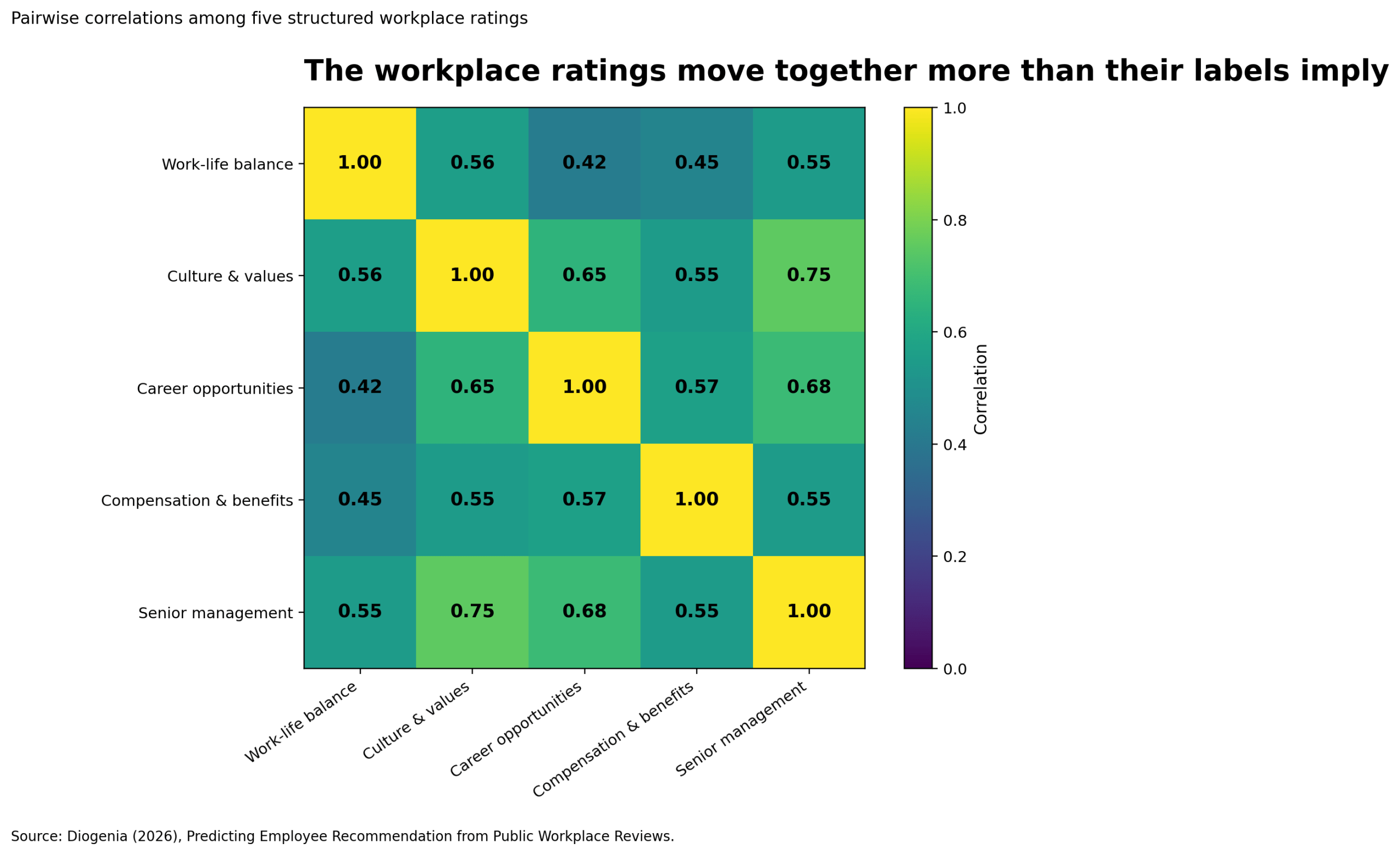
Exploratory factor analysis reinforced the same pattern. All five ratings loaded strongly on a common latent dimension, with the largest loadings appearing for senior management, culture and values, and career opportunities.
| Structured rating | Loading on common factor |
|---|---|
| Work-life balance | .628 |
| Culture and values | .836 |
| Career opportunities | .765 |
| Compensation and benefits | .679 |
| Senior management | .858 |
The most revealing result came from the model comparison. The model using all five raw ratings achieved ROC-AUC of .929; replacing those five measures with a single latent workplace-evaluation factor produced ROC-AUC of .928. Compressing the five subratings into one general evaluative dimension therefore cost almost nothing in predictive performance.
This does not mean that employees are incapable of distinguishing compensation from management or work-life balance from career opportunity. Those distinctions can be operationally important, especially within a particular organization. The finding instead suggests that public workplace ratings contain a substantial amount of shared evaluative signal, meaning that an employee's broader judgment of the employer may express itself across several nominally separate dimensions at once.
For managers, that creates a reason to be cautious when reading small movements among correlated subratings as though each represented a clean diagnosis. A dashboard can display five numbers without proving that five independent organizational mechanisms produced them.
5. Why negative employee voice adds information
The structured ratings already contained a large amount of predictive information, yet the open-ended text still added something useful. Adding sentiment and text-length features to the one-factor model increased ROC-AUC from approximately .928 to .934, a modest improvement that nevertheless indicates that the language employees use cannot be reduced entirely to their overall workplace rating.
The more interesting result appeared when the pros and cons were modeled separately. A text model using only the pros reached ROC-AUC of .788, while a model using only the cons reached .837. Negative employee voice was therefore considerably more discriminating in this dataset than positive employee voice.
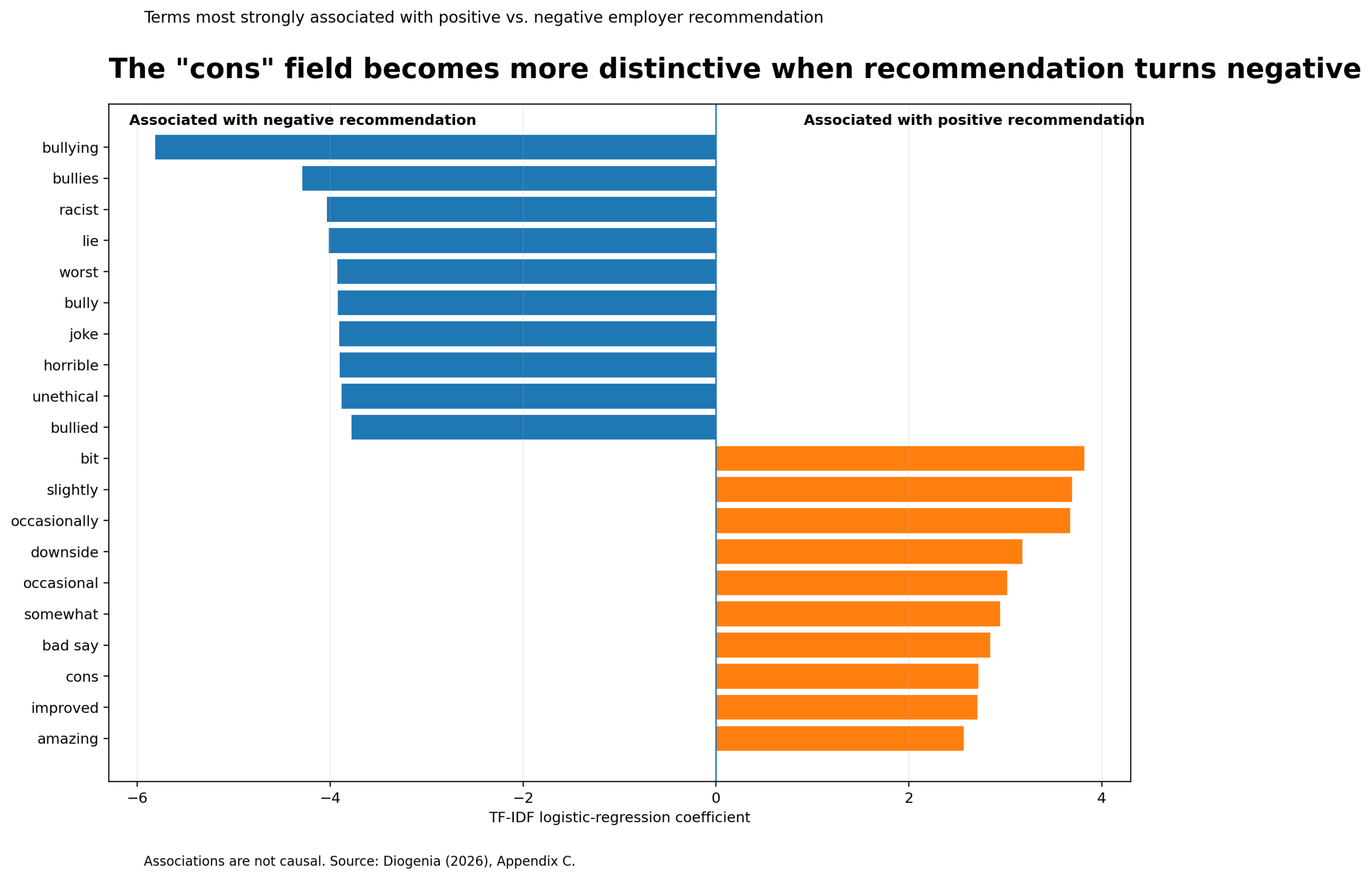
The positive-recommendation side of the cons field tended to contain hedged criticism — words such as slightly, occasionally, somewhat and downside. The negative-recommendation side was associated with considerably sharper language, including bullying, racist, unethical, harassment, dysfunctional, corrupt and toxic.
Those terms should not be read as verified descriptions of the employers represented in the data, nor does their statistical association establish that any particular allegation caused an employee to withhold a recommendation. What the pattern demonstrates is that language can preserve specificity, severity and context that disappear when workplace experience is reduced to an average rating.
A one-point decline can reflect many different experiences. Narrative voice can sometimes tell management whether employees are describing an inconvenience, an organizational dysfunction, perceived mistreatment, or an ethical concern — distinctions that are difficult to recover once everything has been compressed into a score.
Ratings can tell an organization that sentiment moved. Narrative employee voice can help reveal what kind of experience employees believe moved it.
6. Employer-brand resilience and firm-level variation
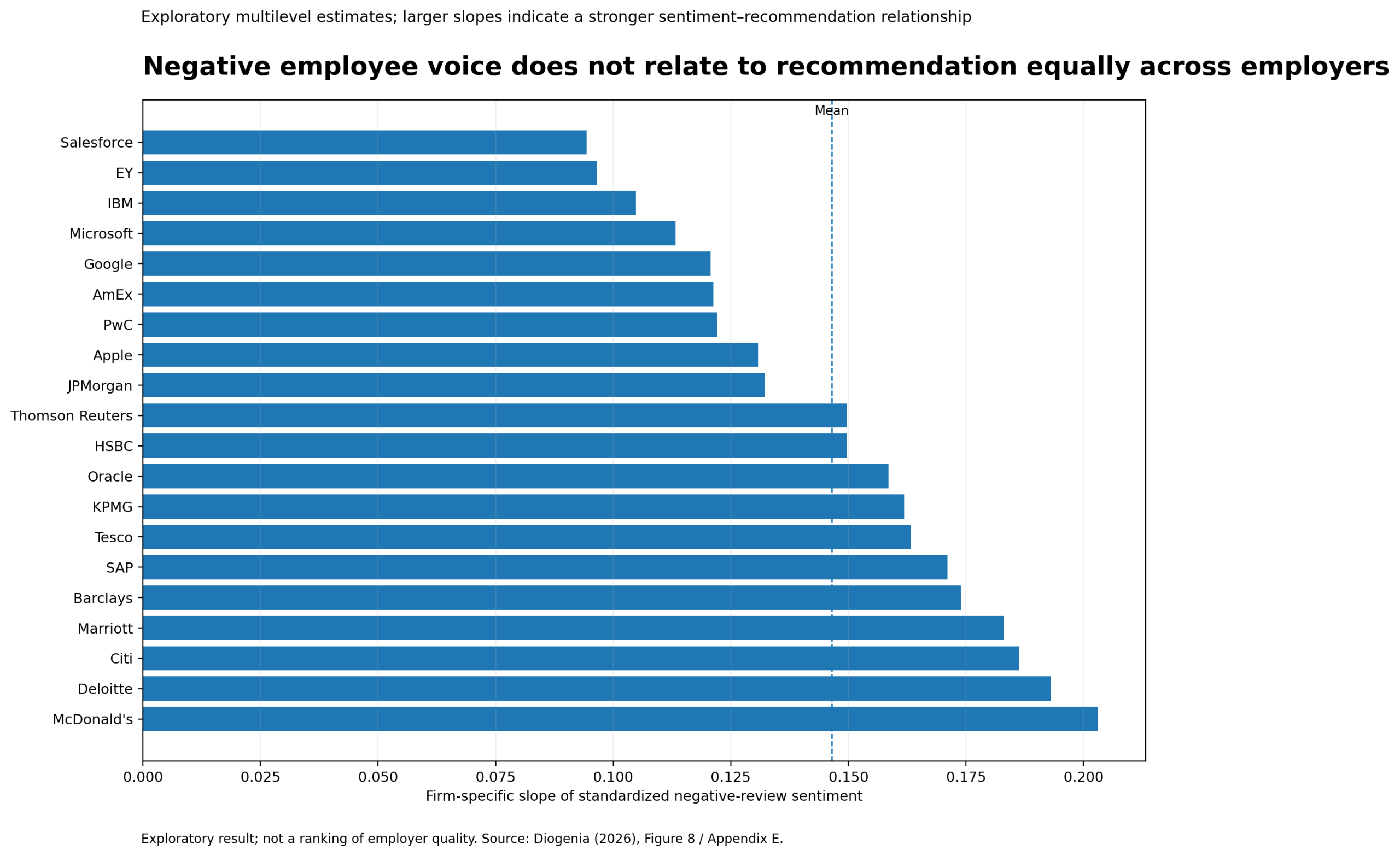
The most exploratory portion of the project asked whether negative employee voice related to recommendation in the same way at every employer. Two supplementary approaches were used: a firm fixed-effects interaction model that allowed the slope of cons sentiment to vary by company, and a multilevel logistic model with firm-specific random intercepts and slopes.
Both approaches suggested meaningful heterogeneity. In practical terms, a comparable difference in the tone of negative employee voice was associated with a larger difference in recommendation for some employers than for others.
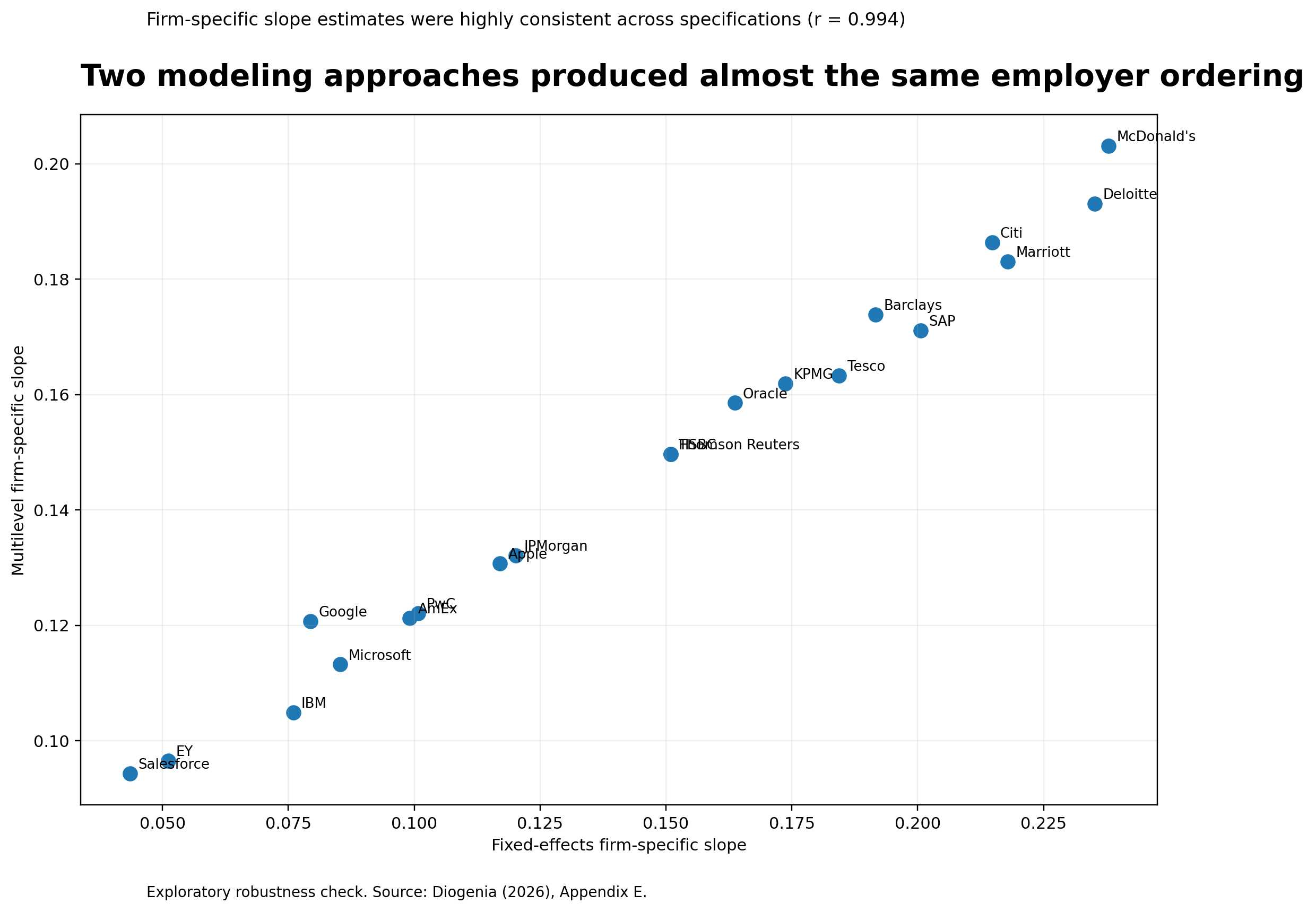
The striking result was not simply that the firms differed, but that the company-specific slope estimates produced by the two modeling approaches were almost identical in rank order and magnitude. Their correlation was r = .994, indicating that the observed pattern was highly consistent across the two specifications, even though the multilevel fitting routine generated a convergence warning that makes caution appropriate.
Could this reflect employer-brand resilience?
Consumer marketers have long recognized that brands do not respond identically to negative information. A brand with accumulated trust, loyalty, familiarity or emotional attachment may sometimes withstand a complaint, failure or burst of negative user-generated content better than a weaker brand because the new information is interpreted through an already established relationship.
That raises an intriguing question in employment. An employer with substantial reputational capital might possess greater employer-brand resilience, allowing some deterioration in employee voice to occur without producing an equally large deterioration in advocacy. Another employer may operate with less reputational margin for error, making recommendation more sensitive to changes in negative voice.
Employer-brand resilience was not directly measured in this project. The analysis establishes that the relationship between negative-review sentiment and recommendation varied across employers; brand equity, loyalty, applicant behavior and outside reputation were not measured. Employer-brand resilience is one possible explanation for the observed heterogeneity and a question for future research.
That qualification is important because the more useful scientific question is not whether one company is “more resilient” than another, but why negative employee voice appears to carry different associations with recommendation across organizational contexts. Industry, employer familiarity, organizational identification, labor-market alternatives, consumer-brand spillover and the credibility of an employer's external promise are all plausible explanations that would require direct measurement.
7. What the findings mean for eNPS
The analysis also provides a useful way to think about employee Net Promoter Score, because an eNPS-style recommendation question compresses a complicated employment experience into one global judgment: would this employee recommend the organization as a place to work?
The strong common factor helps explain why such a question can contain real information. If employees' ratings of management, culture, opportunity, compensation and work-life balance share a substantial general evaluative component, then a global recommendation item can function as a compact signal of broader employer sentiment.
The same findings show why recommendation cannot substitute for richer employee listening. Knowing that an employee would not recommend the organization says little, by itself, about whether the underlying concern involves leadership behavior, career mobility, compensation, workload, psychological safety, ethical conduct, interpersonal treatment or several conditions operating simultaneously. The narrative results show that some of the most consequential information appears precisely where the compressed score becomes least diagnostic.
This is also why an eNPS number should not be treated as though its simplicity supplies psychometric completeness. A global item may efficiently summarize an overall attitude while still having narrower content coverage than a well-designed multi-item employee survey, and the additional step of converting responses into Promoters, Passives and Detractors can discard distinctions that matter for interpretation.
This conclusion complements my separate research on Net Promoter Score and eNPS , which examines why recommendation metrics became so organizationally durable despite important limitations in what they measure. The present analysis adds an empirical perspective: a global recommendation signal can contain substantial information about an employee's overall evaluation of the workplace while still leaving much of the underlying experience unexplained.
The reasonable use case is therefore modest but useful: eNPS can help an organization notice movement, especially when the method is stable, while richer survey items, operational data and employee voice help explain what the movement means.
8. How organizations should use public employee-review data
Public employee reviews are often treated in one of two unhelpful ways: either as an unfiltered revelation of an organization's “true culture” or as unrepresentative internet complaining that serious leaders can safely ignore. Neither position is especially defensible.
The reviews are self-selected, they are influenced by the context in which they are written, and they cannot be assumed to represent the workforce as a whole. At the same time, they contain naturally occurring employee voice produced outside the organization's own listening architecture, which is precisely why they may surface information that conventional internal surveys do not.
A better approach is to treat public reviews as one layer of an employee-listening system and interpret them alongside internal engagement data, retention and turnover, exit interviews, ethics reports, manager-level information, recruiting outcomes and other organizational evidence.
A broad movement across correlated ratings may reflect a general change in employer sentiment rather than several unrelated failures.
Average ratings can remain comparatively stable while the specificity or severity of negative employee voice changes.
Current and former employees, occupational groups, geographies and event-driven bursts of reviews may produce very different signals.
A change in the number of employees choosing to speak can matter even when the average sentiment has not yet moved.
Public reviews become more informative when they are triangulated with representative internal data and operational evidence.
A monitoring system should identify patterns worth investigating, not automatically label an organization or employee group as healthy, unhealthy or “toxic.”
The objective should not be to build an algorithm that converts employee language into an automatic verdict. It should be to use different forms of evidence for what each is good at: structured ratings for efficient summary, narrative text for specificity and context, representative surveys for designed measurement, and organizational data for evidence about what employees actually experience and do.
9. Limitations, reproducibility and future research
Several limitations define what the present findings can support. First, public workplace reviews are self-selected, so the people who choose to post cannot be assumed to constitute a representative sample of employees. The Gauthier dataset is also historical, meaning that none of the firm-level results should be interpreted as current assessments or rankings of the employers represented in it.
Second, the structured ratings and recommendation outcome were collected in the same review event. The resulting relationships may therefore reflect, in part, common-method effects and an underlying evaluative tone that influences several responses at once. That possibility is central to the factor-analysis interpretation rather than an incidental statistical footnote.
Third, VADER sentiment scores and TF-IDF features are deliberately simplified representations of language. They can expose broad patterns but cannot reliably capture every form of sarcasm, context, narrative sequence, ambiguity or allegation contained in an employee review.
Most importantly, the analysis is predictive rather than causal. High ROC-AUC does not mean that changing a particular workplace rating will cause recommendation to change, nor do text-model coefficients prove that the associated terms caused the outcome.
The employer-level analysis deserves an additional qualification. The near-identical firm ordering across fixed-effects and multilevel specifications is encouraging, but the multilevel variational-Bayes routine issued a convergence warning. The heterogeneity result is therefore best treated as an exploratory finding that warrants more direct testing rather than as a completed theory of employer brands.
Data, code and reproducibility
The project was completed in 2026 for BCIS 566: Machine Learning and Predictive Analytics at New Mexico State University. The public repository contains supporting project materials and code for the Glassdoor recommendation analysis.
Where the research could go next
The technical pipeline could be strengthened through nested cross-validation and more systematic hyperparameter tuning, boosted or stacked models, richer text representations, job-title and location features, class weighting and threshold optimization. Those extensions would improve the predictive exercise, but the more interesting next steps may involve measurement and organizational theory.
Future work could test whether the common workplace-evaluation factor replicates across industries, companies, employee groups and time periods; whether some dimensions become more distinct under particular organizational conditions; whether changes in public employee voice precede movements in turnover, recruiting outcomes or internal engagement; and whether employer familiarity, brand equity, organizational identification or consumer-brand strength explain the firm-level heterogeneity observed here.
In that sense, one of the most useful outcomes of the project may be that a predictive model produced a question prediction alone cannot answer.
10. Employee-review research FAQ
Are Glassdoor reviews representative of employees?
Not necessarily. Public workplace reviews are self-selected, which means employees who choose to post may differ systematically from those who do not. They are therefore better interpreted as a naturally occurring form of employee voice than as a probability sample of the workforce.
Can workplace ratings predict whether somebody recommends the employer?
Within this dataset, yes. Logistic regression using five structured workplace ratings achieved ROC-AUC of approximately .929, substantially outperforming the majority-class baseline. The result demonstrates strong association within the review data, not causal prediction of future employee behavior.
Which workplace rating mattered most?
Senior management, culture and values, and career opportunities had the largest coefficients in the raw structured model. Because the five ratings were strongly interrelated and loaded on a common factor, however, they should not be interpreted as five cleanly independent causal drivers.
Why did one factor perform almost as well as all five ratings?
The ratings shared substantial common variance. A model using one latent workplace-evaluation factor achieved ROC-AUC .928, compared with .929 for the five raw ratings, suggesting that much of their predictive power reflects a broader global evaluation of the employer.
Were negative employee reviews more informative than positive ones?
The open-ended “cons” were more predictive of recommendation than the “pros” in this analysis, with ROC-AUC .837 versus .788. That does not establish that negative reviews are more accurate or representative; it indicates that negative employee voice was expressed more distinctly in this dataset.
What kinds of negative language were associated with negative recommendations?
Among the strongest terms were “bullying,” “racist,” “unethical,” “harassment,” “dysfunctional,” “corrupt” and “toxic.” These are associative text-model features and should not be interpreted as causal effects or independently verified descriptions of any employer.
Does this analysis validate eNPS?
Only in a limited conceptual sense. The strong common factor helps explain why a global recommendation item can capture broad employee sentiment, but it does not establish that eNPS has sufficient content coverage or psychometric properties to replace richer employee-survey instruments.
What is employer-brand resilience?
In this guide, employer-brand resilience is a proposed explanation for an observed pattern rather than a directly measured construct. The analysis found that the relationship between negative employee-review sentiment and recommendation varied across employers; additional research would be needed to determine whether employer-brand equity, loyalty, organizational identification or some other mechanism explains that variation.
Can the firm-level findings be used to rank employers?
No. The data are historical, the analysis was not designed as an employer-quality ranking, and the firm-level models estimate differences in the relationship between sentiment and recommendation rather than absolute organizational quality.
What is the main practical lesson?
Different employee-listening mechanisms answer different questions. Structured ratings efficiently summarize evaluation; a recommendation item compresses overall sentiment even further; open-ended voice supplies specificity and context; and representative internal surveys offer measurement discipline that self-selected public reviews cannot provide. No one source should be treated as though it were the employee experience itself.
A useful signal requires room for complexity
Organizations understandably want employee listening to produce a manageable number of metrics, because metrics can be trended, benchmarked, placed on dashboards and carried into meetings. The danger comes when the convenience of the measure begins to dictate our understanding of the phenomenon.
The Glassdoor analysis suggests that structured workplace ratings contain a powerful common signal about how employees evaluate the organization overall, while the language employees use — especially when describing what has gone wrong — adds information that those ratings cannot fully capture. The further finding that negative voice appears to relate differently to recommendation across employers suggests that the same criticism may not have the same meaning or consequences in every organizational context.
That leaves us with a somewhat less tidy but more useful conclusion: employee voice is not one metric, and no single listening channel deserves to be treated as though it were the employee experience itself.
Research note: This article translates an empirical machine-learning and predictive-analytics project completed at New Mexico State University in 2026. The analysis has not been peer reviewed and should be interpreted in light of the self-selected, historical review data and the predictive rather than causal research design. Glassdoor is a trademark of Glassdoor LLC. This independent project is not affiliated with, sponsored by, or endorsed by Glassdoor.
Notes and sources
- David Gauthier (2017), Glassdoor Job Reviews, Kaggle. Dataset
- Edward L. Thorndike (1920), “A Constant Error in Psychological Ratings,” Journal of Applied Psychology, 4(1), 25–29. DOI
- Philip M. Podsakoff, Scott B. MacKenzie, Jeong-Yeon Lee & Nathan P. Podsakoff (2003), “Common Method Biases in Behavioral Research: A Critical Review of the Literature and Recommended Remedies,” Journal of Applied Psychology, 88(5), 879–903. DOI
- C. J. Hutto & Eric Gilbert (2014), “VADER: A Parsimonious Rule-based Model for Sentiment Analysis of Social Media Text,” Proceedings of the International AAAI Conference on Web and Social Media, 8(1), 216–225. DOI
- Elizabeth W. Morrison (2014), “Employee Voice and Silence,” Annual Review of Organizational Psychology and Organizational Behavior, 1, 173–197. DOI
- Russell A. Matthews, Lena Pineault & Y.-H. Hong (2022), “Normalizing the Use of Single-Item Measures: Validation of the Single-Item Compendium for Organizational Psychology,” Journal of Business and Psychology, 37, 639–673. DOI
- Galit Shmueli (2010), “To Explain or to Predict?” Statistical Science, 25(3), 289–310. DOI
- Stefan Baehre (2024), “From Research to Action: Enhancing Net Promoter Score Utilization in Managerial Practice,” International Journal of Market Research, 66(2–3), 174–181. DOI
- Marco Cazzaro & Paolo M. Chiodini (2023), “Statistical Validation of Critical Aspects of the Net Promoter Score,” The TQM Journal, 35(9), 191–209. DOI
- Supporting code and project materials: Patrick Diogenia, Glassdoor Recommendation Analysis — GitHub